| |
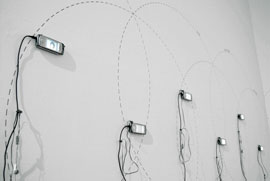
© Dashed II
|
|
|
| WV-Nr. |
|
|
| Titel (title) |
|
|
| Technik (technique) |
| Medieninstallation (media installation) |
|
|
| Format (medium) |
| 10-12 Mobiltelefone, 10-12 mp4 Videos (Interviews), Wandgrafik (variiert) |
|
|
| Entstehungsjahr (year of production) |
|
|
| Entstehungsland (country of production) |
|
|
| Maße/Länge (size/length) |
|
|
| Mitwirkende/Partner (assistent/partners) |
| Interviewpartner (Interviewees): Steven Methewson, Surachai Sutthisasanakul, Jeff Derksen, Joanna Lewis, Johannes Auvinen, Jonathan Quinn, Thomas Crawley, Andrea Lumplecker, Marina Haydn, Genoa Mungin, Megan Bodley; Dariusz Kowalski (Technische Assistenz) |
|
|
| Unterstützt durch (supported by) |
| Stadt Wien (City of Vienna) |
|
|
| ------- |
|
|
| Auflage (Edition) |
| 1 (gemeinsam mit Dashed I) |
|
| Preis (prise) |
|
| Signatur/Dating/Bezeichnung (signature/dating/designation) |
| Signatur (Master Tape), DVD, Mobiltelefone, Anleitung |
|
|
| Standort (location) |
| Österreich/Wien, (Austria/Vienna) |
|
|
| Besitz (courtesy) |
| Kulturabteilung der Stadt Wien (Cultural Department of the City of Vienna), 2006 |
|
|
| ------- |
|
|
| Ausstellungen (exhibitions) |
| • Closeness, E:vent London, GB 2005 • zeitRaumzeit, K/Haus Wien, Wien/Vienna, A 2008 • Fluid Architectures, Montevideo/NIMK Amsterdam, NL 2009 • Prelude*), Hafen2 | interim.projekte, Offenbach am Main, D 2010 • Locate Me, Kunstraum Kreuzberg/Bethanien, Berlin, D 2010 • Space Affairs, MUSA, Wien/Vienna, A 2012 |
|
|
| Festivals (festivals) |
|
|
| Vertrieb (distribution) |
|
|
| Literaturnachweis (reviews) |
| Gesellschaft bildender Künstler Österreichs Künstlerhaus (Hg.), zeitraumzeit, Folio Verlag, Wien 2008 • Zentrum für Kunst und Wissenstransfer, Beatrix Sunkovsky (Hg.), Stelle, Siedelung, Lager, Edition Selene, Wien 2008 |
|
|
| Schlagworte (keywords) |
|
|
| Lizenzvertrag/Archiv (licence contract/archive) |
|
|
| Verkauf/Vergabe 1 (selling/disposal 1) |
|
|
| Verkauf/Vergabe 2 (selling/disposal 2) |
|
|
| Verkauf/Vergabe 3 (selling/disposal 3) |
|
|
| Verkauf/Vergabe 4 (selling/disposal 4) |
|
|
| Verkauf/Vergabe 5 (selling/disposal 5) |
|
|
| ------- |
|
|
| Beschreibung - D (description german) |
| Die Verbindung von gelebtem Raum und Information in Form der Mnemotechnik fungierte von der Antike bis in die Renaissance als privilegierter Modus des Erinnerns komplexer Texte und Informationen. Das zentrale Moment der Mnemotechnik ist es, umfangreiche Informationen an Orte und Wege durch architek-tonische Formationen zu binden und sie so einerseits mit der subjektiven, motorischen Erinnerung des Navigierens durch solche Orte, andererseits mit der visuell erfahrenen räumlichen Struktur als Ordnungsprinzip zu verbinden.
In Dashed II wird diese historische Kulturtechnik gewissermaßen umgedreht, indem einzelne Subjekte gebeten werden, Orte, die ihnen aus persönlichen Gründen wichtig erscheinen, detailliert zu beschreiben. Das faszinierende Ergebnis dieser Prämisse ist ein präzises Bild der zentralen Funktion von Räumen als Zeitmagne-ten, an denen sich Erinnerungen, die das gesamte menschliche Sensorium abdecken, anlagern. So erzählt jemand vom Geruch des Rauches von Birken- und Zedernholz in einer kanadischen Holzhütte, von der schwankenden Temperatur, vom Eindruck der verschiedenen Farben und Materialien vor Ort sowie von Handlungen, die sich dort vollzogen haben. Damit wird deutlich, wie die menschliche Erinnerung Orte als Behälter für Sinnesein-drücke über längere Zeiträume hinweg fungieren lässt. Die Ver-wendung von Mobiltelefonen als Bildmedium für die Präsentation der individuellen Erinnerungsbruchstücke verweist auf die Parallelität der verschiedenen Geschichten. Die Gleichzeitigkeit eröffnet dabei eine im Hier und Jetzt angeordnete Ebene des „aktiven“ Erinnerns, und die Verwendung des Mobiltelefons als Platzhalter, der individuellen Subjekten zugeordnet werden kann, setzt somit einen „Chor der Erinnerung“ in Szene.
(Axel Stockburger ) |
|
|
| Beschreibung - E (description english) |
| The connection of spatial experience and information in the form of mnemonics acted from antiquity to renaissance as a privileged mode of memorizing complex texts and information. The central factor of mnemonics is to link extensive information to places and routes through architectural formations and thus connect them on the one hand to the subjective, motor memory of navigating through such places, and on the other, to the visually experienced, spatial structure as the organising principle. In Dashed II, this historical cultural engineering is effectively reversed by asking individual subjects to describe in detail places, which are important to them for personal reasons. The fascinating result of this proposition is a precise picture of the central function of rooms as time magnets, to which memories covering the entire human sensorium are attached. For instance, somebody talks about the smell of smoke from birch and cedar wood in a Canadian cabin, the changing temperatures, the impression of different colours and materials on the spot, as well as the incidents that occurred there. This shows how human memory uses places as containers for sensations over long periods of time. The use of mobile phones as visual medium for the presentation of individual fragments of memory refers to the parallelism of different stories. The synchronism of the stories opens a level of “active” recollection structured in the here and now and the use of the mobile phone as a placeholder that can be assigned to individual subjects thus stages a “choir of memory.”
(Axel Stockburger) |
|
|
)