| |
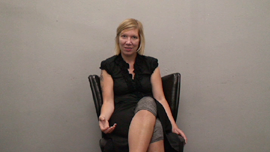
© Fragments - A Lover's Discourse
|
|
|
| WV-Nr. |
|
|
| Titel (title) |
| Fragments - A Lover.s Discourse |
|
|
| Technik (technique) |
|
|
| Format (medium) |
| MiniDV, PAL, 16:9, Farbe (colour), stereo |
|
|
| Entstehungsjahr (year of production) |
|
|
| Entstehungsland (country of production) |
| Luxemburg, Österreich (Luxembourg, Austria) |
|
|
| Maße/Länge (size/length) |
|
|
| Mitwirkende/Partner (assistent/partners) |
| Interviewpartner (Interviewees): Kristoffer Ardena, Veronica Bellei, Claire Blundell-Jones, Ondrej Brody, Fabrice Génot, Bettina Hystad, Annja Krautgasser, Katharina Lackner, Anna Lopez-Luna, Stephanie Mold, Carl Palm, Giuliana Racco |
|
|
| Unterstützt durch (supported by) |
| Produktion des (production within the) Art Workshop 2008, Casino Luxembourg – Forum d’art contemporain |
|
|
| ------- |
|
|
| Auflage (Edition) |
|
| Preis (prise) |
|
| Signatur/Dating/Bezeichnung (signature/dating/designation) |
|
|
| Standort (location) |
|
|
| Besitz (courtesy) |
|
|
| ------- |
|
|
| Ausstellungen (exhibitions) |
| • Dating, Casino Luxembourg, Forum d.Art Contemporain Esche-zur-Alzette, LU 2008 • Prelude*), Hafen2 | interim.projekte, Offenbach am Main, D 2010 • MIND AND MATTER, paraflows.10, Künstlerhaus Wien, Wien/Vienna, A 2010 |
|
|
| Festivals (festivals) |
|
|
| Vertrieb (distribution) |
|
|
| Literaturnachweis (reviews) |
|
|
| Schlagworte (keywords) |
|
|
| Lizenzvertrag/Archiv (licence contract/archive) |
|
|
| Verkauf/Vergabe 1 (selling/disposal 1) |
|
|
| Verkauf/Vergabe 2 (selling/disposal 2) |
|
|
| Verkauf/Vergabe 3 (selling/disposal 3) |
|
|
| Verkauf/Vergabe 4 (selling/disposal 4) |
|
|
| Verkauf/Vergabe 5 (selling/disposal 5) |
|
|
| ------- |
|
|
| Beschreibung - D (description german) |
| Es ist also ein Liebender, der hier spricht und sagt
Nicht ein Liebender – ein modellhafter, ein überpersönlicher –, wie ihn Roland Barthes in Fragmente einer Sprache der Liebe (1977) in Versatzstücken aus Literatur, Philosophie und Geistesgeschichte sprechen lässt, es sind zwölf KünstlerInnen – Liebende –, die in
Annja Krautgassers Video Fragments zur Sprache kommen. Nicht über die Liebe selbst sprechen sie, es sind die Figuren der Liebe, die sie im Moment der Gebärde des in Bewegung erfaßten und nicht des im Ruhezustand betrachteten Körpers artikulieren; es ist der Begriff Dating, anhand dessen zeitgemäßer Strukturen ein Diskurs wiederbelebt werden soll, der – selbst von Tausenden von Subjekten geführt – bereits bei seinem Entstehen von extremer Einsamkeit gekennzeichnet war.
Abhängigkeit, Abwesenheit, Allein, Anbetungswürdig, Angst – Das Video Fragments basiert auf Roland Barthes’ Glossar über die Liebe, dessen alphabetisch geordneten Textbausteinen, Gedankengebilden – wieder: Figuren – gesprochene Interviews beigestellt wurden. Die Struktur des daraus sich fortwährend entwickelnden Discursus – der Rhythmus der Sprechhandlung der Liebenden in den bewegten Bildern – ist vorgegeben durch die Bewegung des Hin-und-Her-Laufens, das ist Kommen und Gehen, das sind „Schritte“, „Verwicklungen“: Unsicherheiten, Schwanken, Neubewertungen, Richtungswechsel. Die Komponenten in Fragments sind nicht mehr enzyklopädisch angeordnet; von BetrachterInnen können sie nur linear – Bild für Bild, Satz für Satz, Figur für Figur – erfahren werden. Askese: „I think ... I think the word means, if I am not mistaken, to actually‚ empty yourself. It’s like the Buddhist going to the mountain? Who is trying to ‚empty‘ himself.“ Atopos, Auswege, Begegnung, Beiläufigkeiten, Bejahung, Berührungen: „It can be, whether you have the urge, the desire to touch the other person. I think, that’s really important! In terms of dating and ... I think, pretty early on in terms of dating someone, you can tell, if you feel for them, or not, because of this sort of electricity. This non-verbal, kind of inner feeling you get.“ Betretenheit, Bild, Brief, Dämonen, Drama: Die Choreografie der Videobilder – die Wahl einer „dramatischen“ Methode – ist nicht auf Analyse angelegt, es geht nicht um die Sprache über die Liebe, sondern um die Sprache der Liebe und die Inszenierung einer in ständigem Wechsel befindlichen Ausdrucksweise des Ich – erster Sprache (keiner Metasprache), individueller Sprache, parole.
Die Ordnung ist nur eine scheinbare Ordnung, die sich an die unvordenklich alte Konvention des Alphabets hält. Eifersucht, Einbezogen, Einverständnis, Entstellung, Entwertung, Entwirklichung: „It is disreality, because of the net because it’s not real space or it’s not a real meeting. At the beginning you just create something for this little group of two.“ Ein verhaltenes Lächeln, leicht beschämt darüber, sich über die Liebe zu äußern und dabei auf das Leben zu referieren – Bejahung und Wiederbejahung: Eben das sagte die Stimme von X ...
(Franz Thalmair) |
|
|
| Beschreibung - E (description english) |
| So It Is a Lover Who Speaks and Who Says
It is not one lover—a model lover, a supra-individual one—like the male voice used by Roland Barthes in his book A Lover’s Discourse: Fragments (Fragments d’un Discours Amoureux, 1977) who uses modular components from the fields of literature, philosophy, and intellectual history; it is twelve artists—lovers—who speak in Annja Krautgasser’s video Fragments. They do not talk about love itself, they articulate the figures of love in the moment of the body’s gesture caught in action and not in contemplated repose; it is the contemporary structures of the notion of “dating” that should reinvigorate a discourse—itself pursued by thousands of subjects—already of an extreme solitude from the outset.
S’abimer, absence, adorable, affirmation, altération, angoisse—the video Fragments is based on Roland Barthes’ love glossary, with the alphabetically arranged building blocks of text, intellectual constructs—again: Figures—augmented by spoken interviews. The structure of the resulting ongoing and developing dis-cursus—the rhythm of the lovers’ speech acts in the moving images—is predetermined by the action of running here and there, comings and goings, measures taken, “plots and plans”: insecurities, vacillation, reappraisal, a shift in direction. The components in Fragments are no longer arranged like an encyclopaedia; they can only be experienced linearly by the viewers—image for image, sentence for sentence, figure for figure. Askesis: “I think ... I think the word means, if I am not mistaken, to actually ‘empty yourself’. It’s like the Buddhist going to the mountain? Who is trying to ‘empty’ himself.”
Atopos, attente, cacher, casés, catastrophe, circonscrire, cœur: “It can be, whether you have the urge, the desire to touch the other person. I think, that’s really important! In terms of dating and ... I think, pretty early on in terms of dating someone, you can tell if you feel for them, or not, because of this sort of electricity. This non-verbal, kind of inner feeling you get.” Comblement, compassion, comprendre, conduite, connivence: The choreography of the video images—the choice of a “dramatic” method—is not based on analysis, it is not engaging with language about love but in the language of love and the presentation of a mode of expression of the I that is in continual flux—primary language (no metalanguage), individual language, parole.
The order only appears to be an order that adheres to the age-old convention of the alphabet. Contacts, contingences, corps, déclara-tion, dédicace, démons: “It is disreality, because of the net because it’s not real space or it’s not a real meeting. At the beginning you just create something for this little group of two.” A restrained smile, slightly embarrassed at talking about love while referring to life—affirmation and reaffirmation: that is what X’s voice was saying ...
(Franz Thalmair) |
|
|
)