| |
© Romanes
|
|
|
| WV-Nr. |
|
|
| Titel (title) |
|
|
| Technik (technique) |
|
|
| Format (medium) |
| Beta SP, 16:9, Farbe (colour), stereo, engl. Untertitel (engl. subtitles) |
|
|
| Entstehungsjahr (year of production) |
|
|
| Entstehungsland (country of production) |
| Österreich, Italien (Austria, Italy) |
|
|
| Maße/Länge (size/length) |
|
|
| Mitwirkende/Partner (assistent/partners) |
| Antonello Casalini, Elena Ferro, Armin Krautgasser, Debora Mantecca, Wolfgang Oblasser + Cassandra, Daniel, Ivan, Romana, Robert, Roberto, Simone, Vesna and Walter |
|
|
| Unterstützt durch (supported by) |
| Villaggio Attrezzato di Via dei Gordiani, Rom (Rome) |
|
|
| ------- |
|
|
| Auflage (Edition) |
|
| Preis (prise) |
|
| Signatur/Dating/Bezeichnung (signature/dating/designation) |
|
|
| Standort (location) |
|
|
| Besitz (courtesy) |
|
|
| ------- |
|
|
| Ausstellungen (exhibitions) |
| • Cella, Complesso Monumentale, Rom/Rome, I 2009 • Giants and Mosquitoes, Salzburger Kunstverein, Salzburg, A 2011 |
|
|
| Festivals (festivals) |
| • Visions du Réel – Festival International du Cinéma Documentaire, Nyon, CH 2010 • VIS Vienna Independent Shorts, Wien/Vienna, A 2010 • dokumentART – Europäisches Dokumentarfilmfestival, D-Neubrandenburg und PL-Szczecin, 2010 • Int. Short Film Festival, Uppsala, S 2010 • Int. Film Festival, Cork, IRL 2010 • Youki – Internationales Jugend Medien Festival, Wels, A 2010 • IDFA - Internationales Dokumentarfilm Festival Amsterdam, Amsterdam, NL 2010 • Wand 5 – 24. Filmwinter, Stuttgart, D 2010 • Glasgow Short Film Festival, Glasgow, GB 2010 • One World Romania documentary film festival, Bukarest, RO 2010 • International Documentary Film Festival, Iowa City, USA 2011 • LIDF – London Internationale Documentary Festival, London, GB 2011 • This Human World Festival, Wien/Vienna, A 2011
|
|
|
| Vertrieb (distribution) |
|
|
| Literaturnachweis (reviews) |
|
|
| Schlagworte (keywords) |
|
|
| Lizenzvertrag/Archiv (licence contract/archive) |
|
|
| Verkauf/Vergabe 1 (selling/disposal 1) |
|
|
| Verkauf/Vergabe 2 (selling/disposal 2) |
|
|
| Verkauf/Vergabe 3 (selling/disposal 3) |
|
|
| Verkauf/Vergabe 4 (selling/disposal 4) |
|
|
| Verkauf/Vergabe 5 (selling/disposal 5) |
|
|
| ------- |
|
|
| Beschreibung - D (description german) |
| „We live in a shit camp.“
Rom, Roma, Romania, Romana
Das Forschungsprojekt Self-Made Urbanism hat die Via Casilina in Rom als Erkundungsachse durch die Metropole bis hin zum Rand der Stadt ausgewählt. Zwischen Pasolinis ehemaligem Accattone-Lokal, wo sich in den frühen 1960er Jahren die Kleinkriminellen trafen, bis hin zum Selbstbau-Stadtteil Borghesiana, errichtet von mehrfach Migrierten, erstreckt sich eine Achse der informellen und selbstproduzierten Stadt. Dazwischen lag die inzwischen geräumte, überaus große Roma-Siedlung Casilino 900, zu der wir wegen der anhaltenden Polizeibedrohung leider keinen Zugang mehr erhalten hatten. Stattdessen wurden wir von mehreren Roma-Familien zum gemeinsamen Grillen bei ihren Hütten an der Autobahn Richtung Meer eingeladen.
Nicht weit von Casilino 900 befindet sich das von zwei Wachposten kontrollierte Containerlager Villaggio Attrezzato, aus dem die Videobilder für Annja Krautgassers Video- und Kunstprojekt Romanes stammen. Dieses Lager ist offensichtlich keine aus der Not selbstproduzierte Siedlung, sondern eine staatlicherseits zugewiesene Zwangsmaßnahme.
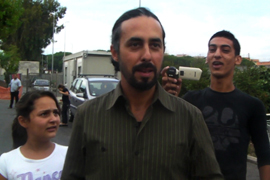
Der kurze Film Romanes ist aus den 270 Minuten Material eines Workshops entstanden, in welchem die jugendlichen BewohnerInnen des Lagers sich gegenseitig vor der Kamera befragen und diese auch selbst bedienen. Sie erhalten und geben sich eine Stimme, ein Gesicht, einen Körper. Das Mädchen Romana beschreibt eine Realität, in der das Verlassen des Camps ihr Hobby bedeutet und eine unerreichte „Normalität“ außerhalb der Bewachung wartet, mit Haus, Auto und Familie, wie es Vesna artikuliert.
„Wir sind alle Italiener“, spricht eine Stimme hinter der Kamera, doch Romana empfindet es als in Rom geborene Roma nicht so. Ihr Platz, der Platz der Romanas, der Roma, der Rumänen oder exjugoslawischen Bürgerkriegsflüchtlinge, ist der Rest zwischen Schnellstraßen und Brücken, Autobahnen und Zugtrassen.
An anderer Stelle hatte ich über die inzwischen geräumte Roma-Siedlung Gazela geschrieben, deren Name von der gleichnamigen Autobahnbrücke in Neu-Beograd stammt und die Europa mit Asien verbindet. Außer den wohl tausend BewohnerInnen in ihren über zweihundert Behausungen kommt hier kaum jemand vorbei, es sei denn, es soll etwas verkauft, Müll rasch abgeladen, Leute verprügelt oder Molotowcocktails geworfen werden.
„Wir“ schauen freundlich vorbei. Die Kamera fertigt und festigt Selbstpositionierungen. Die Frage bleibt offen, ob dies wahrgenommen wird. Und was machen „wir“ da, mit unseren Augen, Kameras und Körpern? Bestätigen „wir“ nicht im Besuch das „ihr“?
Ein Schock ist der kurze Schwenk auf einen Mast, an dem in alle Richtungen ausgerichtete Videokameras befestigt sind. Das römische Roma-Lager wird dauerüberwacht; der Staat macht sich hier ein ununterbrochenes Bild. Indem die Kameras herabblicken, konstituieren sie kontinuierlich das „Andere“. Was zurückbleibt, sind HD-Videokameras, welche den Jugendlichen nach dem Workshop geschenkt wurden.
(Jochen Becker)
|
|
|
| Beschreibung - E (description english) |
| „We live in a shit camp.“
Rom, Roma, Romania, Romana
The Self-Made Urbanism research project took Via Casilina in Rome as the axis for exploring the metropolis out to the edge of the city.
Between Pasolini’s former Accattone Bar, where small-time criminals used to meet in the early 1960s, to the self-built district of Borghesiana, built by immigrants, stretches the main axis of the informal self-built town. In-between lay the now cleared major Roma settlement Casilino 900, to which we unfortunately did not gain access due to the continuing threat posed by the police. Instead, we were invited by several Roma families to join them for a barbecue next to their huts on the motorway leading to the sea.
The portacabin camp of Villaggio Attrezzato, controlled by two armed guards, is situated not far from Casilino 900, the location of the images for Annja Krautgasser’s video and art project Romanes. This camp is clearly not a self-built emergency settlement but a state-imposed coercive measure.
The short film Romanes is the product of the 270 minutes of footage shot during a workshop where the young residents of the camp interview one another before the running camera, which they also operate themselves. They receive and give themselves a voice, a face and body. The girl Romana describes a reality where her hobby means leaving the camp, where an unachieved “normality” outside the surveillance is waiting, with a house, a car, and a family, as Vesna expresses it.
“We are all Italians,” says a voice behind the camera, but Romana does not see it like that as a Roma born in Rome. Her place—the place for the Romanas, the Roma, the Romanians, or refugees from the civil war in ex-Yugoslavia—is on the remnants of land between the highways and bridges, the motorways and access routes.
In another publication, I wrote about the now evacuated Gazela Roma settlement that links Europe with Asia, and is named after the motorway bridge in Novi Beograd. Except for what must be one thousand occupants in over two hundred dwellings, hardly anybody comes here unless something needs selling, to quickly dump refuse, beat people up, or to throw Molotov cocktails.
“We” visit amicably. The camera captures and consolidates its own position. The question remains open as to whether anybody will grasp this. And what are “we” doing there, with our eyes, cameras, and bodies? When “we” visit doesn’t it only confirm the “them”?
The short pan to a mast where video cameras point in all directions is a shock. The Roman Roma camp is permanently under surveil-lance; the state has an uninterrupted stream of images of this place. The cameras look down, so continuously creating the “other.” What remains are HD video cameras that were given to the youths when the workshop was over.
(Jochen Becker)
|
|
|
)