| |
© IP-III
|
|
|
| WV-Nr. |
|
|
| Titel (title) |
|
|
| Technik (technique) |
| Medieninstallation, Netzinstallation (media installation, net installation) |
|
|
| Format (medium) |
| interaktive 3- bzw. 4-Kanal-Projektion (3 or 4 channel projection) |
|
|
| Entstehungsjahr (year of production) |
|
|
| Entstehungsland (country of production) |
|
|
| Maße/Länge (size/length) |
|
|
| Mitwirkende/Partner (assistent/partners) |
| In Zusammenarbeit mit Rainer Mandl, Sepp Deinhofer und (and) Michael Aschauer; Soundkomposition (sound composition) Echelon aka Dieter Kovacic |
|
|
| Unterstützt durch (supported by) |
| Kulturabteilung der Stadt Wien, BMUKK, Kulturabteilung des Landes Tirol (Cultural Department of the City of Vienna, BMUKK, Department of Culture of the Tyrolean Regional Government) |
|
|
| ------- |
|
|
| Auflage (Edition) |
|
| Preis (prise) |
|
| Signatur/Dating/Bezeichnung (signature/dating/designation) |
|
|
| Standort (location) |
|
|
| Besitz (courtesy) |
|
|
| ------- |
|
|
| Ausstellungen (exhibitions) |
| • The Chrono-Files, Lothringerhalle 13, München/Munich, D 2003 • O.K spektral 2, OK Centrum für Gegenwartskunst, Linz, A 2003 • coord(), Kunstverein Medienturm, Graz, A 2003 • Postmediale Kondition, Neue Galerie Graz am Landesmuseum Joanneum, Graz, A 2005 • Conditiòn Postmedia, MediLab Madrid/Arco, Centro Cultural Conde Duque, Madrid, E 2006 • The Postmedia Condition, ArtNetLab/12th international festival of computer art, Mesna Galeria, Ljubljana, SLO 2006 |
|
|
| Festivals (festivals) |
| • FCMM, Montral, CDN2002 • Transmediale 02, Berlin, D 2003 • Viper 03 – Internationales Medienkunstfestival, Basel, CH 2003 |
|
|
| Vertrieb (distribution) |
|
|
| Literaturnachweis (reviews) |
| • Margit Rosen, Christian Schoen (ed.), THE CHRONO FILES - FROM TIME BASED ART TO DATABASE, Revolver Verlag 2003 • MIT Press (ed.), Margit Rosen: The Chronofile Society, MIT Press 2005 • Sandro Droschl, Kunstverein Medienturm (ed.), CrossMedia, Folio Publisher, 2007 • Elisabeth Fiedler, Christa Steinle, Peter Weibel (ed.), Postmediale Kondition, Neue Galerie am Landesm. Joanneum Graz 2005 • MIT Press (ed.), Margit Rosen: The Chronofile Society, MIT Press 2005 • O.K Centrum für Gegenwartskunst Oberösterreich (ed.), O.K spektral Broschüre: IP-III, 2004 • Margit Rosen, Christian Schoen (ed.), The Chrono Files - from time based art to database , Revolver Publisher 2003 |
|
|
| Schlagworte (keywords) |
| Netzinstallation, Medieninstallation, Interaktion |
|
|
| Lizenzvertrag/Archiv (licence contract/archive) |
|
|
| Verkauf/Vergabe 1 (selling/disposal 1) |
|
|
| Verkauf/Vergabe 2 (selling/disposal 2) |
|
|
| Verkauf/Vergabe 3 (selling/disposal 3) |
|
|
| Verkauf/Vergabe 4 (selling/disposal 4) |
|
|
| Verkauf/Vergabe 5 (selling/disposal 5) |
|
|
| ------- |
|
|
| Beschreibung - D (description german) |
| [Transgressive Architekturen]
Die netzbasierte Medieninstallation IP-III fokussiert die grundlegende Erweiterung räumlicher und geografischer Konzepte durch die Ausbreitung des Internets im späten 20. Jahrhundert. Als Entwurf einer Annäherung an das Innenleben elektronischer Landschaften eröffnet IP-III den Blick auf die Topologie des Internets als algorithmisch aufgebaute und dynamisch strukturierte Handlungsoberfläche, deren virtuelle Architektur sich durch den stetigen Fluss von Signalen permanent verändert. Die globale Etablierung einer solchen Formation aus wechselnden Strömen, Knoten und Bündelungen numerisch gefasster Informationseinheiten, die wechselweise als offenes Netz mit einer Vielzahl multipler Andockstellen (Internet) oder als kybernetischer Raum (Cyberspace) gedacht wird, bewirkte eine nachhaltige diskursive Verschiebung der Vorstellung von örtlichen Bezugssystemen. Diese wurden traditionellerweise auf Grundbegriffe der euklidischen Geometrie oder das Dispositiv der Zentralperspektive zurückgeführt, während über das Internet ein virtuelles System wechseln-der multilateral verschalteter Verdichtungen geschaffen wurde.
Im Zuge der Intensivierung der Mensch-Maschine-Beziehung durch die Integration immer neuer digitaler Informationstechnologien in den Alltag scheinen diese Umwälzungen der Wahrnehmung jedoch allmählich aus dem Blickfeld zu geraten. Während an den endogenen Zonen des Internets über Bildschirm und Lautsprecher unentwegt Nahverhältnisse mit Informationspaketen auf fernen Servern oder suggestive Beziehungen zu realen Orten und Personen irgendwo da draußen hergestellt werden, beginnt genau diese Perfektionierung digitaler Kommunikation über den radikalen Bruch mit herkömmlichen topografischen Auffassungen hinwegzutäuschen.
Der Paradigmenwechsel setzte schon mit dem Anbruch der Moderne ein. Generell ist er geprägt durch Phänomene der Dislozierung. László Moholy-Nagy reflektierte dies 1922 in seinem Telefonbild EM 1, das als erstes Medienkunstwerk in Echtzeit gilt. Es entstand in telefonischer Kommunikation mit dem Abteilungsleiter einer Schilderfabrik, der Farbmuster exakt nach Anweisung auf Millimeterpapier auftrug. Damit war die Umsetzung eines künstlerischen Konzepts per Datenübermittlung auf technischem Weg zum Ausdruck gebracht. In ihrer Linearität aber blieb diese Form des Informationstransfers eine Episode. Im Zuge der Entwicklung über analoge Medien wie Telefon oder Radio hin zur globalen Implementierung des Internets erfolgte ein Szenenwechsel. Kommunikationsprozesse lassen sich nicht mehr als Ströme durch vorgezeichnete Kanäle beschreiben, sondern als fraktale Architekturen wechselnder Verschaltungen vorstellen, deren immanente Topologie in stetiger Veränderung begriffen und durch interne Andockmanöver und wechselnde Knotenpunkte gekennzeichnet ist.
Selbstverständlich manifestiert sich in diesem Umbruch eine Dynamik, in der verschiedene kulturelle, ökonomische und soziopolitische Fluchtlinien aufeinandertreffen, doch bewirkte die Verlagerung von Prozessen des Informationsaustauschs in die Kartografie des Internets eine neue räumliche Praxis. Während die Wegstrecken alphanumerisch codierter Datenpakete wechseln oder einander überlagern, entstehen temporäre Schnittlinien, Agglomerationen und Verdichtungen ohne fixierte Geometrie. Für dieses Phänomen einer realen (weil numerisch und technisch definierbaren) und zugleich virtuellen (weil zeitlich und räumlich nicht letztgültig fixierbaren) multidimensionalen Architektur entwickelte Annja Krautgasser mit der Installation IP-III ein variables Repräsentationsformat. Als Dispositiv des Cybermappings greift IP-III auch die in der Kybernetik und den Computerwissenschaften zentrale Fragestellung der Darstellung des Verhaltens von Datenmengen und der Beziehung algorithmischer Strukturen zueinander auf.
IP-III ist im Feld interaktiver Internetprojekte situiert und schließt sowohl an medienreflexive Diskurse der bildenden Kunst wie auch an visionäre Konzepte dekonstruktivistischer Architektur an, welche durch ihre Versuche zur Überwindung der seriellen Kubaturen der Moderne darauf abzielten, die eingetretene Instabilität der Grammatik räumlicher Strukturen sichtbar und ikonisch zu reflektieren. In Fortsetzung eines zunächst über Internet per Bildschirm zugänglichen Projekts reorganisierte und erweiterte Annja Krautgasser IP-III für unterschiedliche Ausstellungsdisplays in begehbare transmediale Installationen aus mehreren per Internet beeinflussten Projektionen verschaltet mit elektronischem Sound.
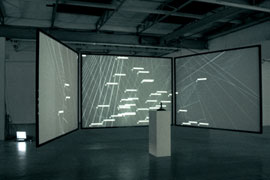
Durch Verfahren grafischer Abstraktion verbunden mit der Option zur virtuellen Navigation durch die Installation per Trackball bildet IP-III im visuellen Zoom jene digital aufgezeichneten Spuren ab, die Internet-User im Zuge ihres Einloggens entweder auf der Homepage der jeweiligen Ausstellungsorte oder der IP-III-Homepage selbst in Form ihrer IP-Adressen hinterlassen. Diese digitalen Spuren werden gesammelt und in Echtzeit visuell und akustisch synchronisiert. Über das Internetprotokoll (IP), das aus einer 32-stelligen Binärzahl besteht, die vierstellig dargestellt wird, schreibt jeder Computer seine numerische Identität als Logfile in das Internet ein. IP-III verbildlicht dies in Form von „flags“ mit den entsprechenden IP-Adressen. Neben der zentralen Information, von welchem Ort aus die User über welchen Computer zugreifen, können Logfiles komplexes Datenmaterial akkumulieren, welches das individuelle Userverhalten automatisch dokumentiert.
Von kommerziellen Interessen geleitet, zeichnen High-Traffic-Sites
auf dieser Basis lokale Parameter der User auf, um soziografische Verhaltensdiagramme zu erstellen. Dazu setzt sich IP-III in Differenz und reflektiert stattdessen die multilateral aufgebaute Architektur des Internets selbst. Die mit Bewegungen im Internet korrespondierende Installation, die Annja Krautgasser in einer Kooperation mit Rainer Mandl, Josef Deinhofer und Michael Aschauer entwickelte und dann für die an das Feld neuer elektronischer Musik rückgebundene Reihe O.K spektral am O.K Centrum für Gegenwartskunst in Linz mit einem Soundkonzept von Dieter Kovacic aka Echelon verknüpfte, reflektiert den Schwenk der räumlichen Wahrnehmung in Richtung eines multiperspektivischen Hybrids, der sich über Cluster von Knoten und Schnittstellen definiert und von linearen Bindungen abrückt. Gilles Deleuze und Felix Guattari deuteten dies in Mille Plateaux als Verschneidung mäandernder segmentärer Systeme an, was in der Sphäre des Internets über binäre Verknüpfungen prozessualisiert wird. Dass die Installation IP-III als räumliche Visualisierung einer Architektur der Transgression entsprechend den auf Basis der digitalen Matrix sowohl lokal am Computer wie auch vernetzt per Internet generierten unterschiedlichen Produktionsformen mit einer dynamischen Struktur elektronischer Sounds verknüpft wurde, die ebenfalls mit der permanenten Veränderung der Zugriffsdaten per Internet korrelierte, verstärkte das utopische Moment einer allseitig offenen, dynamischen Formation. Vor dem Hintergrund der Befreiung der Klänge aus ihren traditionellen Systemen der Notation durch die Diskurse der Avantgarde im Kontext der elektronischen Musik modelliert IP-III durch die Einbeziehung des „acoustic space“ ein sinnlich wahrnehmbares Feld nicht wiederholbarer, zeichenhafter Kondensierungen auf unterschiedlichen Ebenen, die Marshall McLuhan Resonanzen nannte. In Resonanzverhältnissen korrespondieren verschiedene Pole miteinander nach Abläufen, die nicht immer prädisponierbar sind. Wie auch im Umgang mit dem Internet an dessen endogenen Zonen erfolgt die Wahrnehmung sowohl nach Prinzipien der Kausalität wie nach unvorhersehbaren sinnlichen Motiven.
(Roland Schöny) |
|
|
| Beschreibung - E (description english) |
| [Transgressive Architecture]
The net-based media installation IP-III focuses on the fundamental extension of concepts of space and geography caused by the spread of the Internet in the late 20th century. As a design for an approach to the inner-life of electronic landscapes, IP-III opens the view to the topology of the Internet as an algorithmically built and dynamically structured surface for activity whose virtual architecture is perma-nently being altered by the continuous stream of signals. The global establishment of such a formation of alternating currents, nodes, and bundles of numerically encompassed units of data—sometimes conceived of as an open network with a large number of multiple docking points (the Internet) and sometimes as cybernetic space (cyberspace)—triggers a sustainable discursive shift in the notion of systems of local references. These were traditionally rooted in fundamental terms of Euclidean geometry or the dispositif of the central perspective, while by means of the Internet a virtual system of alternating multilaterally linked condensations was created.
In the course of the intensification of the human-machine relation-ship through the integration of continually new digital information technology in everyday life, these radical alterations in perception appear to slip gradually from view. While in the endogenous zones of the Internet, unremitting close relationships are produced via monitors and speakers with packets of data on distant servers or suggestive relationships to existing places and people somewhere out there, this perfectioning of digital communication begins to divert attention from the radical breach with usual notions of topography.
The paradigm shift already began with the emergence of modernism. In general it is marked by phenomena of dislocation. László Moholy-Nagy reflected on this with Telefonbild EM 1 in 1922, which is considered the very first realtime media artwork. It was completed per telephone communication with the head of department at a sign factory, who applied patterns of paint to graph paper exactly according to instructions. This was the expression of the realisation of an artistic concept via the conveyance of data using technology. Although in its linearity, this form of information transfer remained an isolated episode. A change of scene occurred in the course of the development of analogue media like the telephone or the radio up until the global implementation of the Internet. Processes of communication can no longer be described as currents through predetermined channels, but can be regarded as fractal architectures of changing relays, whose immanent topology is in a constant state of flux and characterised by internal docking manoeuvres and changing nodes.
Of course, a dynamism manifests itself in this radical shift where different cultural, economic, and socio-political alignments encoun-ter one another, yet the shifting of information exchange processes in the cartography of the Internet results in a new spatial practise. Temporary interfaces, agglomerations, and condensations occur while the routes taken by packets of data change or overlap without a fixed geometry. For this phenomenon of a real (because they are numerically and technologically definable) and at the same time virtual (because they cannot be fixed in terms of time and space) multidimensional architecture, Annja Krautgasser developed a variable presentation format with the installation IP-III. As a dispositif of cybermapping, IP-III also engages with a key issue in cybernetics and computer science, too, regarding the depiction of the behaviour of quantities of data and the interrelationship between algorithmic structures.
IP-III is situated in the field of interactive online projects and connects with both media-reflective discourses in the field of art and visionary concepts for deconstructivist architecture which aimed, through their attempts to overcome modern serial cubature, to reflect the onsetting instability of the grammar of spatial structures visibly and iconically. In the continuation of a project initially accessible online per monitor, Annja Krautgasser reorganised and extended IP-III for different exhibition displays as walk-in transmedial installations consisting of several projections influenced by the Internet and wired to electronic sound.
As a result of the process of graphical abstraction linked with the
option for virtual navigation through the installation using a track-ball, in digital zoom, IP-III depicts the digitally recorded tracks that Internet users leave in the form of their IP addresses when they log-in to either the websites of the relevant exhibition venues or to the IP-III homepage. These digital tracks are collected and synchronised visually and acoustically in realtime. With the Internet Protocol (IP), every computer writes its numerical identity online as a Log file consisting of a 32-digit binary number. IP-III visualises this in the form of “flags” with the appropriate IP addresses. Alongside the key information, from which location and with which computer the users are accessing the web, Log files can accumulate complex data that automatically documents the user’s online behaviour.
Led by commercial interests, using this basis, high-traffic sites record users’ local parameters to compile sociographic behavioural diagrams. IP-III has a different orientation here, and reflects instead the multilaterally constructed architecture of the Internet itself. The installation that corresponds with movements in the Internet—which Annja Kratgasser developed with Rainer Mandl, Josef Deinhofer, and Michael Aschauer, and then linked with a sound concept by Dieter Kovacic (aka Echelon) for the O.K spektral, a series of electronic music events at the O.K Centrum für Gegenwartskunst in Linz—reflects the swing of spatial perception towards a multi-perspectival hybrid that defines itself through clusters of nodes and interfaces and shifts away from linear limitations. Gilles Deleuze and Felix Guattari interpreted this in Mille Plateaux as a mix of meandering segmentary systems, which in the sphere of the Internet is processualised via binary links. That the installation IP-III, as a three-dimensional visualisation of an architecture of transgression (with different forms of production generated by the digital matrix: locally on the computer as well as networked online), was linked to a dynamic structure of electronic sounds that also correlated with the permanent changes of the access data per Internet strengthened the utopian moment of a dynamic formation that is completely open. Before the background of the emancipation of sounds from their traditional systems of notation by the discourse of the avant-garde in the context of electronic music, by integrating the acoustic space, IP-III models a sensually perceptible field of unrepeatable, sign-like condensations on different levels, which Marshall McLuhan called “Resonance.” In resonance relationships, different poles correspond with one another according to processes that are not always predefinable. As in the treatment of the Internet in its endogenous zones, the perception occurs both according to principles of causality as well as in the pursuit of unpredictable sensual motifs.
(Roland Schöny) |
|
|
)