| |
© To Live within One's Means
|
|
|
| WV-Nr. |
|
|
| Titel (title) |
| To Live within One.s Means |
|
|
| Technik (technique) |
| Wandobjekt, Intervention, Installation (sculpture, staging, installation) |
|
|
| Format (medium) |
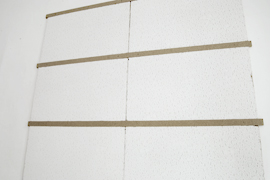
| montierte Deckenplatten mit Sperrholzunterkonstruktion (ceiling slabs with plywood construction) |
|
|
| Entstehungsjahr (year of production) |
|
|
| Entstehungsland (country of production) |
| Österreich, Niederlande (Austria, The Netherlands) |
|
|
| Maße/Länge (size/length) |
|
|
| Mitwirkende/Partner (assistent/partners) |
|
|
| Unterstützt durch (supported by) |
| Leihgabe (Item on loan by): agentur: |
|
|
| ------- |
|
|
| Auflage (Edition) |
|
| Preis (prise) |
|
| Signatur/Dating/Bezeichnung (signature/dating/designation) |
|
|
| Standort (location) |
|
|
| Besitz (courtesy) |
|
|
| ------- |
|
|
| Ausstellungen (exhibitions) |
| • Depth of Texture, Gallery Area53, Wien/Vienna, A 2009 • Passing the Past, P///AKT, Amsterdam, NL 2009 |
|
|
| Festivals (festivals) |
|
|
| Vertrieb (distribution) |
|
|
| Literaturnachweis (reviews) |
|
|
| Schlagworte (keywords) |
| Intervention, Wandobjekt, Aktion |
|
|
| Lizenzvertrag/Archiv (licence contract/archive) |
|
|
| Verkauf/Vergabe 1 (selling/disposal 1) |
|
|
| Verkauf/Vergabe 2 (selling/disposal 2) |
|
|
| Verkauf/Vergabe 3 (selling/disposal 3) |
|
|
| Verkauf/Vergabe 4 (selling/disposal 4) |
|
|
| Verkauf/Vergabe 5 (selling/disposal 5) |
|
|
| ------- |
|
|
| Beschreibung - D (description german) |
| [Sich nach der Decke strecken]
Wandelemente, Boden- und Deckenplatten als Bestandteile von und als Objekte in Kunsträumen wecken Assoziationen. Sie verweisen sowohl in ihrer Form als auch in der Beschäftigung mit ihren Funktionszusammenhängen auf ein dichtes Netz von Referenzen in der jüngeren Kunstgeschichte: So kommt einem z. B. die Minimal Art in den Sinn, die in ihrer Reduktion auf die Grunddeterminanten räumlicher Erscheinung die Relationen des Umraumes und raumfunktionale Aspekte thematisiert. Oder auch Arbeiten der Institutionskritik der 1970er Jahre, die durch Eingriffe in die glatten Oberflächen des White Cube und durch Offenlegung der ästhetischen, sozialen und vor allen Dingen auch ökonomischen Kontexte die vermeintliche Neutralität des Galerie- und Museumsraumes als Mythos entlarvten.
Die sechs Deckenplatten an einer Galeriewand in Wien und das ebenfalls dort ausgestellte Foto einer Zimmerdecke, der offen-sichtlich diese Platten fehlen, wodurch der Blick auf die darunter ansonsten verborgenen Entlüftungsschläuche, Kabelstränge etc. freigegeben wird, erinnern zwar an die oben angeführten kunstgeschichtlichen Bezugspunkte, der Titel der Arbeit, To Live Within One’s Means. Sitting in Amsterdam – Watching a Hole in the Ceiling, lenkt die Gedanken jedoch in eine andere Richtung. Die Deckenplatten fehlen ja eben nicht in der Galerie, sondern an einem anderen Ort, welcher dem Titel nach anscheinend in Amsterdam zu finden ist. Dieser Spur folgend entwickelt sich rasch eine gedankliche Verbindung zwischen dem Galerieraum in Wien und dem anderen Ort sowie in einem zweiten Reflexionsschritt auch zwischen dem hier und gerade jetzt stattfindenden Vorgang der Rezeption und dem der künstlerischen Produktion. Während ich die Deckenplatten und das Foto betrachte, scheint die Künstlerin in Amsterdam „ein Loch in die Decke zu starren“. Durch die imaginierte Parallelität der beiden Vorgänge entsteht eine Verknüpfung des vorliegenden materiell-physischen Substrats eines Raumes mit seinen gesellschaftlichen Herstellungs-, Verwendungs- und Aneignungszusammenhängen. Die abwesende Künstlerin und der/die Betrachter/in treten vermittelt über einen „Platzhalter“ in eine Beziehung, welche auf gesellschaftliche Interaktions- und Handlungsstrukturen verweist – in diesem Fall die Prozesse von Produktion und Rezeption von Kunst(werken).
Das „gleichzeitige“ Schauen auf ein Stück (fehlende) Decke erscheint vor diesem Hintergrund aber auch als ein Hinweis auf eine gemeinsame Autorschaft am Kunstwerk.
Studioraum und Ausstellungsraum sowie die damit verbundenen Praxen der Produktion und Rezeption scheinen weit voneinander entfernt – auf den zweiten Blick sind die Tätigkeiten des „Sich-nach-der-Decke-Streckens“, des „Löcher-in-die-Decke-Starrens“ und des „Auf-sechs-Deckenplatten-Schauens“ aber doch sehr nah beieinander.
(Sønke Gau) |
|
|
| Beschreibung - E (description english) |
| [Reaching for the Ceiling]
Wall, floor, and ceiling panels, as composite elements of art spaces and as objects in them, evoke associations. They allude both in formal terms and in the engagement with their functional uses to a dense network of references in the more recent history of art. So, for example, minimal art comes to mind, which, in its reduction to the basic determinants of spatial appearance, addresses the relationship to the environment and spatial function. Or even works of the institutional critique of the 1970s, which revealed the apparent neutrality of the gallery and exhibition space as a myth with interventions in the smooth surfaces of the white cube and by laying open the aesthetic, social and, above all, the economic context.
The six ceiling panels on a gallery wall in Vienna and, also shown there, the photograph of the ceiling to a room where these panels are clearly missing—whereby the view is freed to the otherwise concealed ventilation shafts, lengths of cables, etc. underneath them—may remind one of the abovementioned art historical points of reference, however the title of the work To Live Within One’s Means. Sitting in Amsterdam – Watching a Hole in the Ceiling directs one’s thoughts in another direction. The ceiling panels are not actually missing in the gallery but somewhere else that, according to the title, is to be found in Amsterdam. Following this trail, an intellectual association quickly develops between the gallery space in Vienna and the other place as well as, in a subsequent line of thought, between the processes involved in the reception of the work occurring right here and right now and those of the artwork’s production. While one is looking at the ceiling panels and the photograph, the artist is apparently “watching a hole in the ceiling” in Amsterdam. This imagined parallelism of the two processes links the material substrata of a room with the social contexts of its production, use, and appropriation. The absent artist and the viewer enter into a relationship mediated via a “placeholder” that alludes to the social structures of action and interaction—in this case the processes of the production and reception of art (works). Before this background the quasi-simultaneous acts of looking at a piece of (missing) ceiling also appears, however, to imply a shared authorship of the artwork.
The studio space and the exhibition space as well as the practices of production and reception allied to these appear far apart—at second glance, though, the acts of “reaching for the ceiling,” of “staring holes in the ceiling,” and of “looking at six ceiling panels” are very close to one another.
(Sønke Gau) |
|
|
)