| |
© Ansicht, W139
|
|
|
| WV-Nr. |
|
|
| Titel (title) |
|
|
| Technik (technique) |
| Intervention, Performance (enactment, performance) |
|
|
| Format (medium) |
| Inszenierung, Tanzlektionen (staging, dance lessons) |
|
|
| Entstehungsjahr (year of production) |
|
|
| Entstehungsland (country of production) |
| Niederlande (The Netherlands) |
|
|
| Maße/Länge (size/length) |
|
|
| Mitwirkende/Partner (assistent/partners) |
| Tänzer, Performer (Dancers, Performers): Luc van Esch, Tashi Iwaoka, Sarah van Lamsweerde. Kameras, Tanzlektionen (Cameras, lessons): Krzysztof Wegiel, Julia Willms. Kameras, Intervention (Cameras, enactment): Alex Ivanov, Assen Ivanov, Svebor Kranjc, Krzysztof Wegiel, Julia Willms. Licht (Light setting): Paul Schimmel. Livemusik (Live music): Westhell5. Tonaufnahmen (Audio recording): Alvin van Veen. Musiker (Musicians): Westhell5 |
|
|
| Unterstützt durch (supported by) |
| BMUKK, Kulturabteilung des Landes Tirol (Department of Culture of the Tyrolean Regional Government), W139 (Amsterdam), NewDanceStudios, agentur: |
|
|
| ------- |
|
|
| Auflage (Edition) |
|
| Preis (prise) |
|
| Signatur/Dating/Bezeichnung (signature/dating/designation) |
|
|
| Standort (location) |
|
|
| Besitz (courtesy) |
|
|
| ------- |
|
|
| Ausstellungen (exhibitions) |
|
|
| Festivals (festivals) |
|
|
| Vertrieb (distribution) |
|
|
| Literaturnachweis (reviews) |
|
|
| Schlagworte (keywords) |
| Intervention, Inseznierung, Happening, Videoshooting |
|
|
| Lizenzvertrag/Archiv (licence contract/archive) |
|
|
| Verkauf/Vergabe 1 (selling/disposal 1) |
|
|
| Verkauf/Vergabe 2 (selling/disposal 2) |
|
|
| Verkauf/Vergabe 3 (selling/disposal 3) |
|
|
| Verkauf/Vergabe 4 (selling/disposal 4) |
|
|
| Verkauf/Vergabe 5 (selling/disposal 5) |
|
|
| ------- |
|
|
| Beschreibung - D (description german) |
| Madison ist der Name eines Gesellschaftstanzes, der Anfang der 1960er Jahre aus den USA nach Europa kam und seine Verbreitung hauptsächlich über Filme fand. Es handelt sich dabei um eine vorgegebene Schrittkombination, bei der sich die Tänzer in einer Reihe nebeneinander ohne Körperkontakt bewegen – zu Swing gewordene Coolness quasi.
Annja Krautgassers Adaption des Themas Madison bezieht sich auf eine berühmte Szene aus dem Film Bande à part (dt. Titel: Die Außenseiterbande) von Jean-Luc Godard aus dem Jahr 1964 und nimmt damit auch jenen medialen Referenzfaden auf, dem der Tanz seine Beliebtheit zu Beginn der 1960er Jahre in Europa verdankt. In dieser Szene – die zu den Schlüsselszenen des Films gehört – tanzen die drei Protagonisten Odile, Franz und Arthur den Madison in einem Pariser Bistro, als ob sie dort allein wären. Der Vereinzelung als Gruppe im sozialen Körper, die sie auch als gesellschaftliche Außenseiter erfahren, entspricht die spezielle Tanzform des Madison: Als „line dance“ wird er zwar von mehreren Akteuren gleichzeitig getanzt, jedoch ist jede Person dabei isoliert und bewegt sich nicht direkt mit einem Gegenüber als Partner.
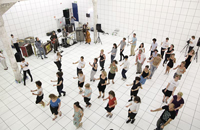
Krautgassers Remake der Szene findet in einem Amsterdamer Kunstraum statt, der hier einerseits den institutionellen Rahmen eines White Cube vorgibt und andererseits durch die laufende Intervention The Cartesian Grid des Künstlers Bernd Trasberger bestimmt ist. In dieser Arbeit wird die Neutralität des Kunstraums durch ein weißes, rationales Gittermuster zwar überhöht, aber gleichzeitig auch durchbrochen, indem Trasberger Versatzstücke älterer Kunstprojekte als Hinweise auf gesellschaftliche Utopien in den Kunstraum hereinholt. So enthält auch Krautgassers Intervention utopisches Potenzial, wenn sie ihr Projekt in einem sowohl abstrakten als auch mit konkret-utopischen Vorstellungen belegten Kontext ansiedelt. Le Madison wurde mit einer Liveband und mit rund vierzig Tänzerinnen und Tänzern, die einem Aufruf übers Internet gefolgt waren und die Schritte zuvor einstudiert hatten, aufgeführt. Im Gegensatz zur ursprünglichen Filmszene standen dabei die kollektive Erfahrung und das gemeinsame Wissen um und im Tanz im Vordergrund. Im performativen Reenactment verschiebt sich der Ansatz der Aufführung hin zu einer Öffnung in ein gesellschaftlich größeres Ganzes und deutet dadurch auch auf die symbolische Öffnung eines Kunstraums – mithin in eine Form von Institutionskritik.
Damit verbindet sich weniger eine direkte politische Botschaft wie noch bei Adrian Pipers Funk Lessons von 1982, in denen die Künstlerin einem weißen Publikum beibrachte, zu afroamerikanischer Funkmusik zu tanzen, um dadurch rassistische Voreingenommenheiten in kulturelles Verständnis umzulenken. Die Intention verschiebt sich bei Krautgassers Arbeit vielmehr auf die Ebene der (Selbst-)Reflexion, indem hier auch die Autorschaft und die Rolle als Künstlerin durch eine implizierte Distanznahme zur Disposition stehen.
(Patricia Grzonka) |
|
|
| Beschreibung - E (description english) |
| The Madison is the name of a line dance that came to Europe from the USA at the beginning of the 1960s, spread chiefly via film. The dance consists of a predetermined combination of steps by dancers who move without touching each other while standing alongside one another in a line—coolness gone Swing, so to speak.
Annja Krautgasser’s adaptation of the Madison theme is an allusion to a famous scene in the 1964 film Bande à part (Band of Outsiders) by Jean-Luc Godard, and so also to the medium responsible for the dance’s popularity in Europe in the early 1960s. In the scene concerned, one of the key scenes of the film, the three main characters Odile, Franz, and Arthur break into the Madison in a Paris bistro as if they were the only people there. The isolation as a group within the social corpus that they also experience as outsiders is expressed in the particular form of the Madison: as a line dance it is carried out by several participants at the same time, although each person involved does so in isolation and not with a partner as a direct counterpart.
The venue for Annja Krautgasser’s remake of the scene is an Amsterdam art space that provides the institutional framework of a white cube characterised by the then current intervention The Cartesian Grid by the artist Bernd Trasberger. In this work, the neutrality of the art space is exaggerated by a rational white grid while also being broken to the extent that Trasberger also introduced items from older art projects to allude to social utopianism. So Krautgasser’s intervention also contains utopian potential when the venue for her project is a context that is both abstract and occupied by concrete utopian ideas. Le Madison was performed with a live band and with about forty dancers who had answered an online call for participants and studied the steps in advance. In contrast to the original film scene, it was the collective experience and shared knowledge about and in the dance that were in the foreground. In performing the re-enactment, there is a shift in the approach as it opens up towards a larger social context, so suggesting the symbolic opening up of an art space—i.e. to a form of institutional critique.
It is less of a direct political message of the kind seen in Adrian Piper’s Funk Lessons, 1982, where the artist showed a white audience how to dance to Afro-American funk music to redirect racist prejudice into cultural understanding. The intention shifts in Krautgasser’s piece more onto a level of (self-) reflection to the extent that here the authorship and the role of the artist are posited by an implicit adoption of distance.
(Patricia Grzonka) |
|
|